
Quick answer
If you are arriving in Geneva by car, the easiest option is usually to park once and use public transport. Central parking can be limited, expensive and confusing for first-time visitors. Leave the car at your hotel, an official underground car park or a P+R park-and-ride, then use trams, buses, trains, boats and walking to get around.
If you are staying in eligible Geneva accommodation, check whether you have a free Geneva Transport Card before buying tickets.
Is Geneva easy to drive in?
Geneva is not especially difficult to drive in, but a car rarely makes city life easier. The centre is compact, central streets are busy, parking rules vary, and traffic around the lake, Cornavin, the airport and border crossings can be slow at peak times.
For a short visit, the practical plan is simple: drive to Geneva, park the car, then use public transport while you are here. This is especially useful around the lake, Cornavin, Pâquis, Plainpalais, Eaux-Vives, Carouge, the Old Town and the international organisations.
Best option: park once, then use public transport
Geneva’s trams and buses cover most places visitors need. Local trains help with longer trips, and the yellow Mouettes genevoises boats provide short lake crossings. If your accommodation offers parking, use it, then ask for the nearest tram or bus stop.
The Geneva Transport Card, when provided by eligible accommodation, can save both money and the hassle of finding parking each time you go somewhere.
Using a P+R park-and-ride
A P+R lets you leave your car outside the busiest parts of the city and continue by public transport. It is useful for a day visit, when your hotel has no parking, when arriving from France or another Swiss canton, or when you do not need the car during the day.
Choose a P+R on your route into Geneva rather than driving across town to reach another one. Some daily formulas include parking and a public-transport ticket; check the current option before travelling.
Parking in central Geneva
If you need to park centrally, use an official underground car park rather than relying on a street space. Search around Cornavin, Mont-Blanc, Rive, Plainpalais, Saint-Antoine, Eaux-Vives, Pâquis or Nations, depending on your destination.
For the Old Town, look near Saint-Antoine or Rive. For the station, look near Cornavin. For the lake and Pâquis, search around Mont-Blanc. Check availability before driving in if possible; it is much easier than circling narrow streets at the end of a journey.
Street parking in Geneva
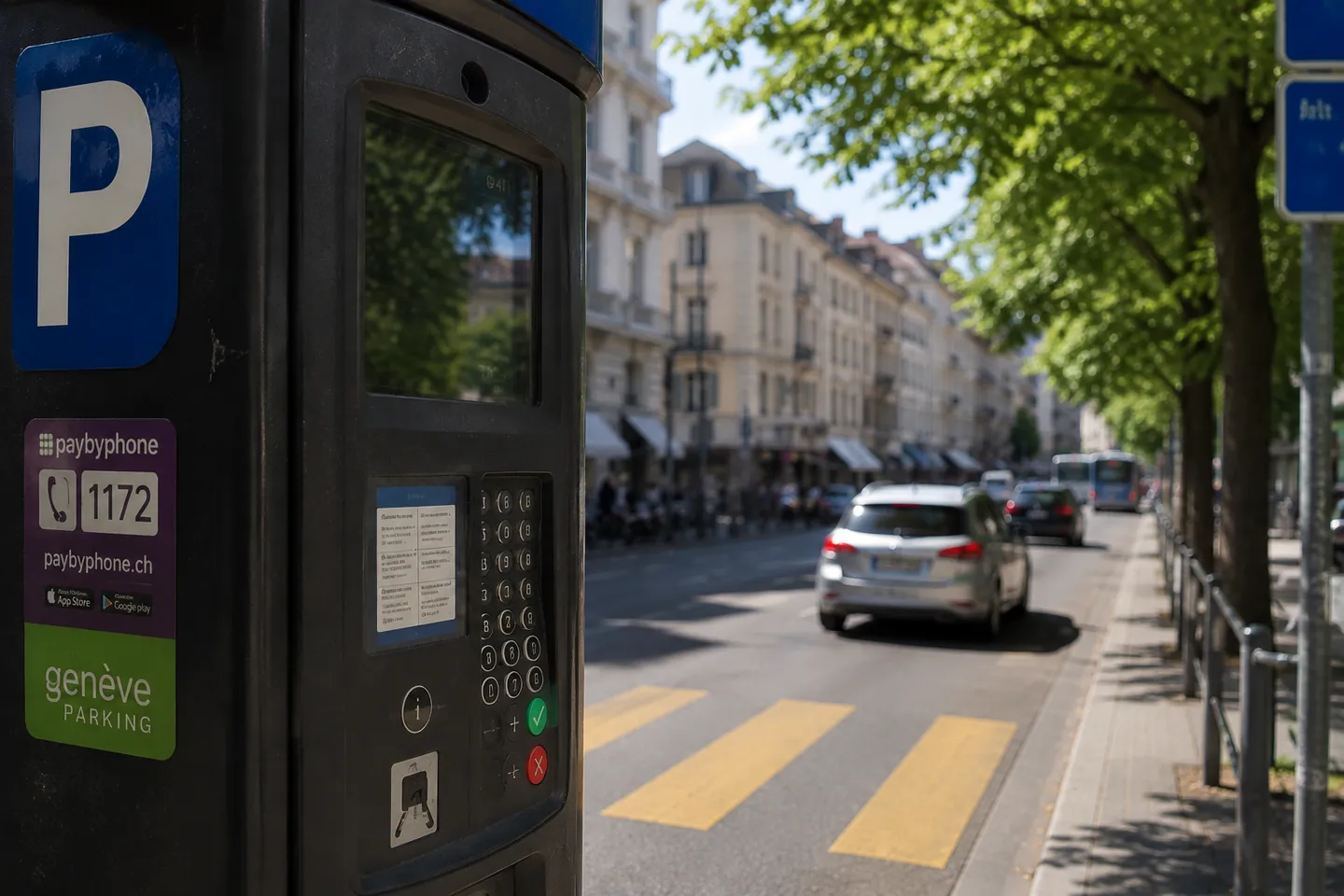
Street parking exists, but is rarely the simplest visitor option. White zones can be time-limited, free or paid. Blue zones require an official blue parking disc. Yellow delivery spaces are not normal parking spaces.
Always check the sign, markings, time limit and payment requirement. If you are not confident reading the rules, use an underground car park. It may cost more, but it is clearer.
Swiss motorway vignette and driving from France
You need a Swiss motorway vignette if you use Swiss motorways, even for a short distance. It is available as a physical sticker or electronic vignette. Check your route before travelling, particularly if arriving from France.
Traffic at the French border can build at weekday commuter times. If you are staying in France and visiting Geneva for the day, a P+R can help you avoid taking the car into the centre.
Hotel, airport and Old Town advice
If your hotel has parking, drive there and leave the car. If it does not, ask for its recommended nearby car park before you arrive. Check whether you need to reserve, whether there is a height limit, the nearest public-transport stop, and whether you will receive a Geneva Transport Card. Save both hotel and car-park addresses offline.
If collecting a rental car at Geneva Airport, check whether the booking is on the Swiss or French side. Avoid driving into the Old Town unless your accommodation or reservation specifically requires it: it is beautiful on foot, but narrow, restricted and short of parking by car.
If you are arriving through the airport before collecting a car, read the Geneva Airport arrival guide first. Once the car is parked, open the map to find places around you or browse English-friendly places by need.
Stick’AIR and electric cars
Geneva’s temporary Stick’AIR traffic restrictions apply during pollution peaks, not as an everyday permanent low-emission zone. If you are driving an older vehicle, especially an older diesel, check the current official situation before travelling.
Some car parks offer EV charging, but availability and payment arrangements vary. Check charging options near your accommodation or planned P+R before arrival.
Frequently asked questions
Is it worth having a car in Geneva?
Not usually if you are staying in the city centre. Geneva is compact, public transport is good and parking can be expensive. A car is more useful for trips outside the city.
Where should I park when visiting Geneva?
For a day visit, consider a P+R park-and-ride. If you need to be in the centre, use an official underground car park near your destination.
Is street parking easy in Geneva?
No. Street parking can be limited, time-restricted, paid or reserved. Visitors are usually better using an underground car park or P+R.
Do I need a Swiss motorway vignette to drive to Geneva?
You need a Swiss motorway vignette if you use Swiss motorways. If your route avoids them, you may not need one, but check before travelling.
Do I need a car to visit Geneva?
No. Most visitors do not need a car to enjoy Geneva. Public transport and walking are usually easier inside the city.
The simple version
Drive in, park once, then use public transport. If your accommodation offers parking, use it. If not, choose an official car park or P+R and let Geneva’s trams, buses, trains, boats and your own feet do the rest.